
In litigation, blockchain evidence verification is becoming essential. Lawyers must prove not just that evidence was disclosed, but when it truly existed. Every lawyer who handles litigation or regulatory matters understands the pressure of disclosure deadlines.
Courts and regulators demand not only that evidence be submitted on time, but that every disclosed document be authentic and untampered. Yet, traditional digital processes still rely on trust — trusting metadata, email timestamps, and internal logs. When opposing counsel challenges authenticity or timing, that trust collapses into uncertainty.
A single allegation that a document was created after a deadline or altered before disclosure can damage a client’s case and a firm’s credibility. Even if the lawyer did everything correctly, without independent verification of timing and authorship, proving it is difficult.
In a world where artificial intelligence can generate convincing forgeries in seconds, the old “we found it in our files” defence no longer satisfies scrutiny.
The Old Process (Without Blockchain Evidence Verification)
The traditional evidence disclosure workflow looks efficient, but its weak points are invisible until something goes wrong. Legal teams collect digital documents, label them as exhibits, and prepare bundles for opposing counsel. The metadata on those files — creation dates, modified times, folder logs — becomes the only evidence of when they were prepared. That data is fragile. Copying a file to another computer or cloud service resets timestamps. Compressing or renaming a file can erase key information.
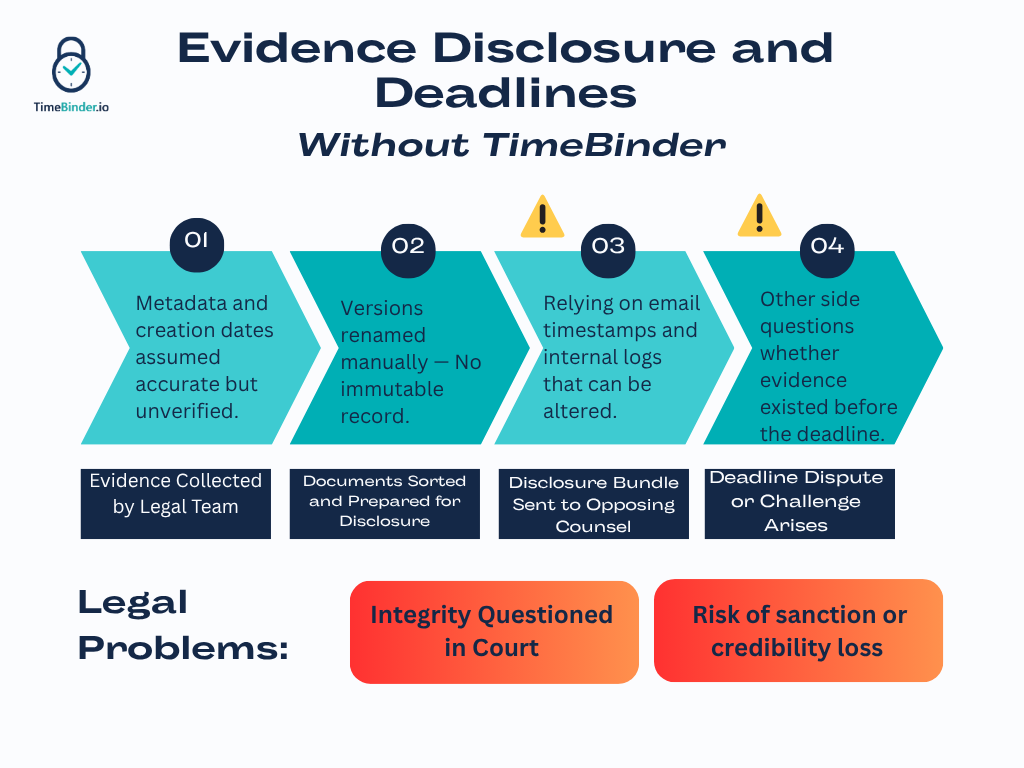
When the disclosure package is sent, the only external record is the email or upload time. If a dispute arises later — for example, one party claims evidence was produced late or fabricated — lawyers scramble to rebuild a timeline using screenshots and file properties. Those artefacts are easily manipulated and carry little evidentiary weight. The entire process depends on the assumption that everyone acted honestly and that the technology was accurate. Courts are no longer willing to rely on those assumptions.
The TimeBinder Process
TimeBinder replaces that fragile chain of trust with cryptographic proof. It fits directly into the disclosure process, requiring no change in workflow — only one added step: TimeBinding each document as it is collected or before it is exchanged.
When a document is TimeBound, its digital fingerprint (SHA-256 hash) is created locally in the browser and then anchored permanently to the Bitcoin blockchain. The file itself never leaves the device, ensuring full confidentiality, while its timestamp becomes immutable and verifiable (you can learn more about how TimeBinder verifies evidence here).
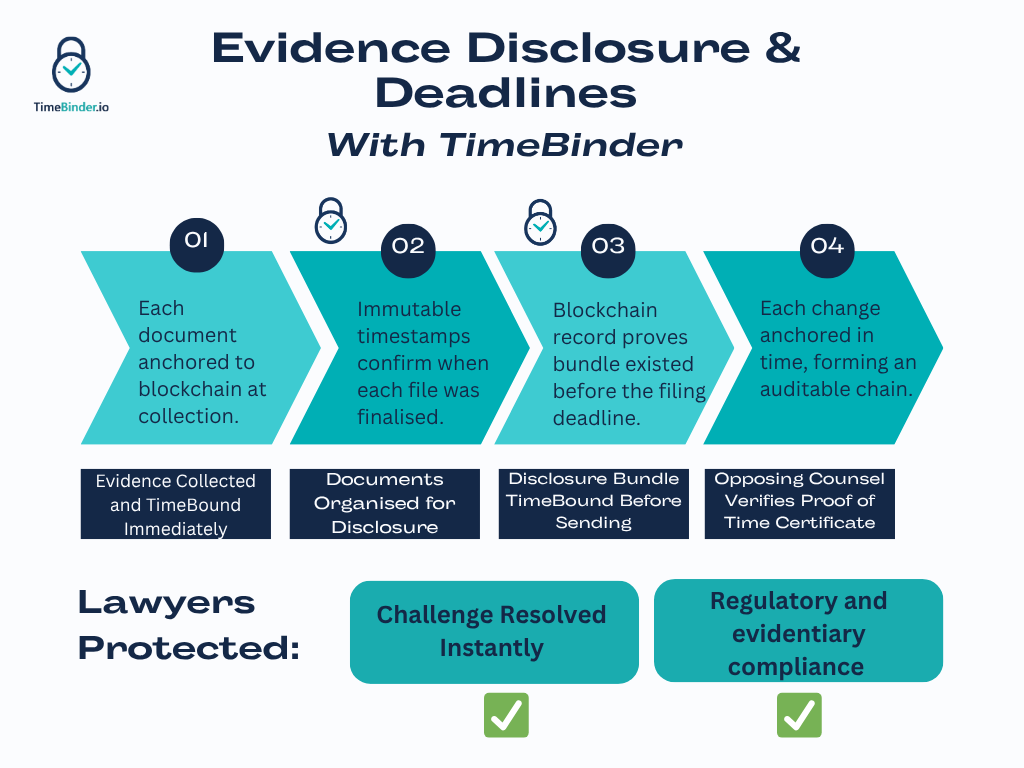
Once each item is TimeBound, the disclosure bundle can also be timestamped as a whole. The resulting Proof of Time Certificate provides verifiable evidence that the entire set of files existed before the disclosure deadline.
If the opposing party questions timing or authenticity, the lawyer presents the certificate — a public blockchain record showing when those hashes were written into the ledger. Verification takes seconds, and no party needs to rely on the other’s systems or statements.
This simple change turns evidence disclosure into a defensible, audit-ready process. It aligns perfectly with electronic discovery and compliance protocols, creating a permanent, court-admissible chain of custody for every file. The process also protects against internal mishaps, such as overwritten files or accidental deletions, because each version’s fingerprint is preserved forever.
Why the Blockchain Can’t Be Broken Even by Quantum Computers!
Since 2009, the Bitcoin blockchain has operated without a single breach, securing trillions of dollars across more than a billion transactions. Blocks are cryptographically linked and distributed across tens of thousands of computers, making the data effectively immutable. Altering any record would require rewriting the entire chain and overpowering the global network’s energy — impossible . Even quantum computing poses no real threat, as Bitcoin’s SHA-256 and elliptic curve cryptography remain resistant and can be upgraded long before quantum attacks become viable.
The Outcome
When disputes over timing or authenticity arise, proof replaces argument. Blockchain records confirm exactly when every disclosed document existed and prove that its contents have not changed since. Lawyers can demonstrate, beyond doubt, that they met deadlines and maintained evidence integrity throughout the process by using TimeBinder’s simple blockchain evidence verification system.
“Deadlines are no longer a matter of trust — they are a matter of proof.”
Adopting TimeBinder transforms evidence disclosure from a procedural risk into a compliance advantage. It eliminates ambiguity, protects firms from allegations of tampering or delay, and reassures clients that their case files are anchored to the most secure network ever built. In an era where AI can rewrite history, blockchain timestamps ensure your evidence keeps its own.

Customised for the Legal Sector
TimeBinder.io provides blockchain evidence verification designed for lawyers, compliance teams, and legal support staff who need reliable, tamper-proof proof of when files existed. From contracts to client records to evidentiary documents, TimeBinder ensures integrity that withstands scrutiny from courts, regulators, and opposing parties.