
Every lawyer knows the pain of version confusion. Files named “Final_v3.docx” or “Latest_Draft_Final(2).docx” circulate by email, shared drives, and client portals. Each recipient opens, edits, and re-saves their own copy. Days later, someone insists a clause was inserted without approval, or that the “agreed version” was different from what was signed. This is where blockchain document verification can revolutionize the process.
The truth is buried in metadata and timestamps that are easily altered or lost in transfer. In an age where AI can generate flawless forgeries, the assumption that an email date or file property can prove timing is dangerously outdated. This is not only inconvenient — it exposes both firms and clients to avoidable disputes, compliance failures, and professional liability.
The Old Process
For decades, the exchange of drafts between lawyers has followed the same pattern. Each side works from its own version of a contract, sharing updates by email or document portal. Every time a file changes hands, the risk grows. There is no single, independent record showing when each version was created, what it contained, or who held it at that time. When disputes arise later, the evidence chain collapses into guesswork.
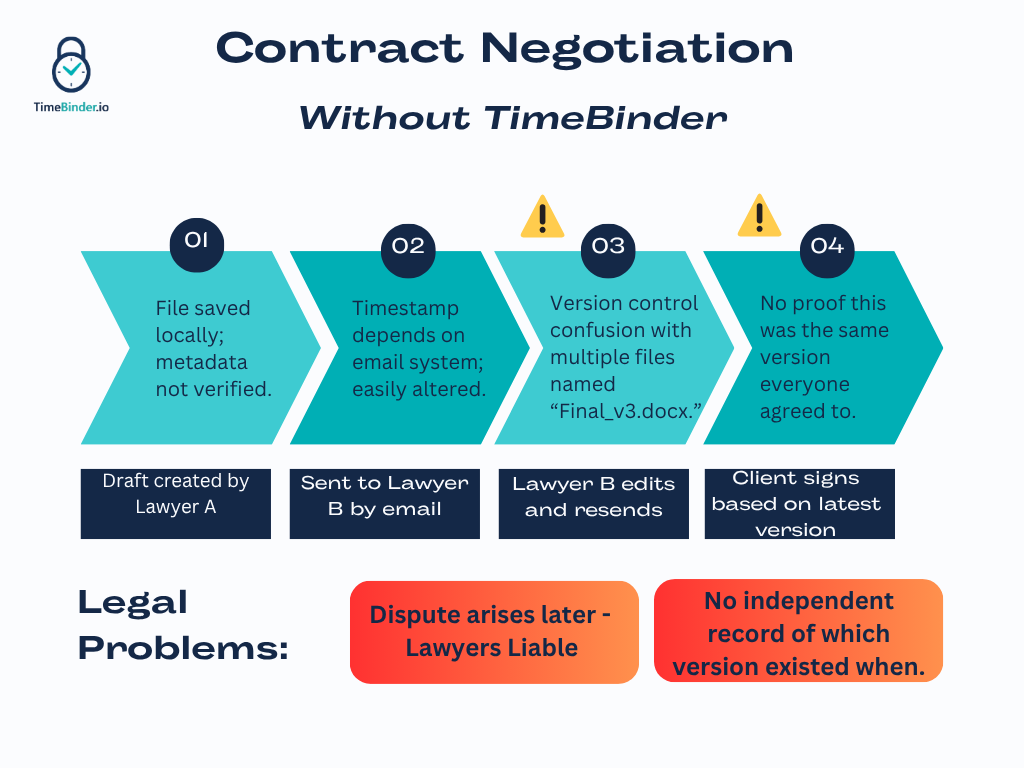
In this legacy process, proof depends on mutable systems: file names, folder structures, and email metadata. A simple “save as” can destroy version history. File metadata, such as creation or modification dates, can be manually edited or stripped during email transmission. Even digital signatures only confirm who signed a document — not when that document truly existed in its current form. Without an immutable reference point anchored outside the firm’s IT environment, authenticity becomes a matter of professional credibility rather than technical certainty.
The risk extends beyond litigation. In mergers, financing, or property transactions, the sequence of contract versions can determine millions in liability. Yet most firms still rely on the same workflow they used twenty years ago, hoping that email timestamps will hold up as evidence. Increasingly, they don’t. Courts and regulators now expect verifiable, tamper-proof digital audit trails. Without them, lawyers face uncertainty in proving which version was the operative one.
The TimeBinder Process
TimeBinder solves this problem without disrupting the way lawyers already work. It adds a single, invisible step that transforms ordinary files into verifiable evidence. Before a draft leaves the firm’s system — whether by email, file share, or client upload — it is TimeBound.
This process takes seconds: the browser creates a unique SHA-256 hash of the file locally (without uploading it anywhere) and anchors that fingerprint to the Bitcoin blockchain. The blockchain’s timestamp becomes an independent, permanent proof of existence. The file itself remains private, but its cryptographic fingerprint and timestamp are public, immutable, and mathematically verifiable.
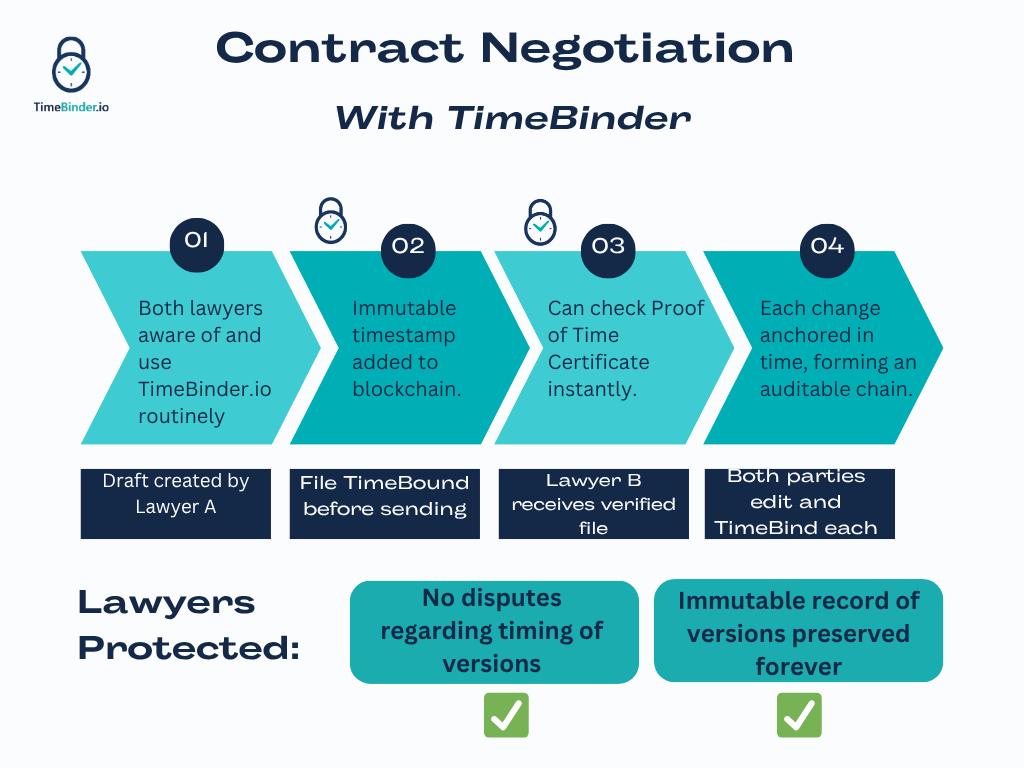
Every subsequent draft can be TimeBound again before being sent or signed, forming an unbreakable chain of evidence. The resulting Proof of Time Certificate records the file’s hash, the blockchain transaction ID, and the exact date and time the file was anchored. Any person with the file can later verify that it existed at that precise time — and that it has not changed since. It doesn’t matter whether the file is renamed, emailed, or stored on different systems. If its contents change by even one character, the verification fails.
Learn more about how TimeBinder provides blockchain document verification at our Verification Page.
For law firms, this means that each version in a contract negotiation has a provable timestamp and a verifiable fingerprint. Opposing parties can independently confirm the timing without relying on one another’s IT systems. Partners can audit document workflows with absolute confidence. Clients gain a permanent, tamper-proof assurance that their contracts and evidence existed when claimed.
Why the Blockchain Can’t Be Broken Even by Quantum Computers!
Since 2009, the Bitcoin blockchain has operated without a single breach, securing trillions of dollars across more than a billion transactions. Blocks are cryptographically linked and distributed across tens of thousands of computers, making the data effectively immutable. Altering any record would require rewriting the entire chain and overpowering the global network’s energy — impossible . Even quantum computing poses no real threat, as Bitcoin’s SHA-256 and elliptic curve cryptography remain resistant and can be upgraded long before quantum attacks become viable.
The Outcome
When a dispute arises, arguments about “which version” end instantly. The blockchain shows which version existed and when, removing ambiguity. The document that was TimeBound first can be proven to pre-date all later versions. Lawyers no longer depend on internal metadata, email trails, or assumptions. They can produce an independently verifiable certificate anchored in the world’s most secure distributed ledger. What was once a matter of trust becomes a matter of proof.
“What was once a matter of trust is now a matter of proof.”
This change doesn’t just protect lawyers in litigation. It strengthens every client relationship by making authenticity measurable, not debatable. TimeBinder eliminates uncertainty at the point where risk begins — before a document ever leaves your hands. For the cost of a few dollars and a few seconds, firms gain lasting protection from version disputes, tampering claims, and AI-powered falsification.
Firms that integrate TimeBinder into daily workflow demonstrate higher compliance maturity and reduce exposure under professional conduct obligations. It’s not another document management system. It’s an evidentiary layer that locks truth into time — and in a world of deepfakes and digital manipulation, that’s quickly becoming non-negotiable.

Customised for the Legal Sector
TimeBinder.io delivers blockchain document verification for lawyers, compliance teams, and legal professionals who need unquestionable proof of when a file existed. Whether it’s a contract, evidentiary record, or client document, TimeBinder provides tamper-proof timestamps that can withstand scrutiny from courts, regulators, and opposing counsel.